

Trump Claims Iran Deal Could Be Signed Within Hours: What It Means for Indian Stock Markets
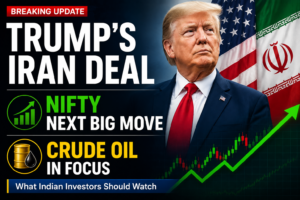
Global financial markets are entering a crucial phase after U.S. President Donald Trump announced that a long-awaited agreement between the United States and Iran could be signed as early as Sunday. The proposed agreement is expected to reopen the Strait of Hormuz, one of the world’s most important oil shipping routes, and potentially bring an end to months of geopolitical uncertainty in the Middle East.
For investors, this is not just another geopolitical headline. The outcome of these negotiations could directly influence crude oil prices, inflation expectations, foreign investment flows and the near-term direction of global equity markets, including India.
Why the Iran Deal Matters
The Strait of Hormuz handles a significant portion of the world’s oil exports. Any disruption in the region immediately affects energy prices across the globe.
Over recent months, tensions between the United States, Iran and Israel have created concerns about energy security and global supply chains. Those concerns pushed investors toward defensive assets and increased market volatility.
A successful agreement could dramatically change that picture.
If the deal is signed and the Strait of Hormuz reopens fully, energy markets may begin pricing in lower geopolitical risk, which could place downward pressure on crude oil prices.
Impact on Indian Stock Markets
India imports the majority of its crude oil requirements.
Lower oil prices generally translate into:
- Reduced inflation pressure
- Lower import costs
- Improved corporate profitability
- Stronger macroeconomic stability
- Better investor sentiment
This is why Indian markets are highly sensitive to developments in the Middle East.
Bullish Scenario
If the agreement is finalized:
- Brent crude may continue to soften
- Foreign investors could increase exposure to emerging markets
- Banking, Auto, Aviation and Consumer sectors may outperform
- Nifty could witness a strong positive opening next week
Risk Scenario
Despite growing optimism, uncertainty remains.
Iranian officials have not fully confirmed Trump’s timeline, and negotiations remain sensitive.
Any delay, disagreement or renewed military escalation could quickly reverse market sentiment and trigger fresh volatility across global markets.
Sector-Wise Impact
Likely Beneficiaries
- Banking Stocks
- Auto Stocks
- Aviation Companies
- Paint Companies
- Consumer Goods Sector
Potential Winners
- Rate-sensitive sectors
- Domestic consumption themes
Risk Areas
- Energy producers may face pressure if crude declines sharply
Why This Deal Matters
Impact on Crude Oil
Impact on Indian Markets
Sector Winners
Risks Investors Should Watch
FineCode Finance AI View
The Bigger Picture
Investors should understand that this development arrives just before several major global events, including the upcoming Federal Reserve meeting and ongoing discussions among global leaders at the G7 Summit.
As a result, markets are likely to remain highly headline-driven.
The combination of a potential Iran deal, softer crude oil prices and supportive global liquidity conditions could create a favorable environment for risk assets.
However, traders should remain prepared for sharp moves in either direction until official confirmation emerges.
FineCode Finance AI View
The proposed U.S.-Iran agreement is currently the single most important global macro event for financial markets.
A successful deal would likely be viewed as a positive development for India because of its potential impact on crude oil prices and investor sentiment.
While optimism is increasing, investors should avoid assuming that the outcome is guaranteed. Until an official agreement is signed and implemented, volatility is likely to remain elevated.
For now, the market bias remains cautiously bullish, but headline risk remains extremely high.https://finecodefinanceai.com/iran-deal-almost-done-india-market-ready-to-rally/?amp=1