
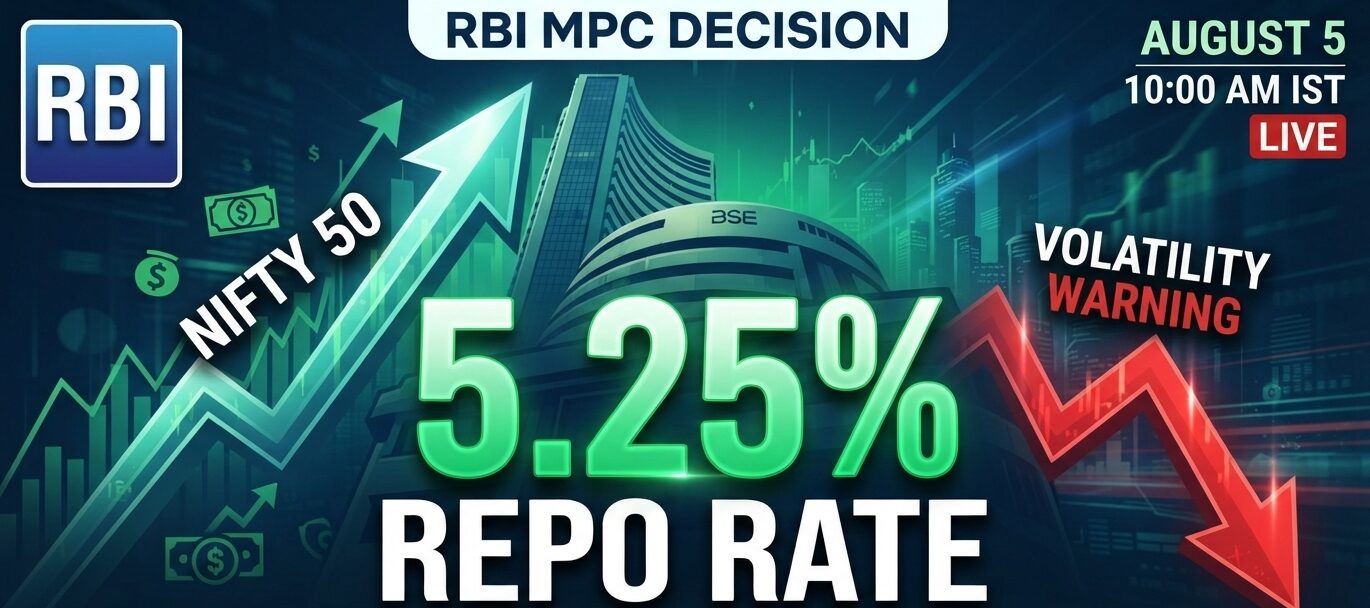

RBI Upcoming Meeting August 2026: Market Projections, Nifty Volatility, and Stock Impact Matrix
MUMBAI — The Reserve Bank of India’s (RBI) rate-setting panel started its highly anticipated three-day bi-monthly monetary policy review on August 3, 2026, with the final policy resolution scheduled for release on Wednesday, August 5, 2026, at 10:00 AM IST. Led by RBI Governor Sanjay Malhotra, the Monetary Policy Committee (MPC) is convening at a complex economic juncture where stable retail data faces mounting wholesale pricing pressures.
Financial markets are pricing in a status quo, but historical algorithmic reactions to the Governor’s live commentary mean traders must prepare for high-velocity intraday moves.
1. The Macro Backdrop: Why the RBI Will Hold Rates Steady
The overarching consensus among 72 institutional economists points toward a 100% priced-in pause, keeping the key repo rate steady at 5.25%. The committee is highly expected to maintain its “Neutral” policy stance to preserve economic stability amidst a volatile global trade landscape.
               [ REPO RATE ANCHOR: 5.25% PAUSE ]
                               │
       ┌───────────────────────┴───────────────────────┐
       ▼                                               ▼
[ THE BULLISH CATALYST ]                        [ THE BEARISH RISKS ]
• Retail Inflation: 4.38%                       • WPI Inflation: 9.87%
• CPI sits safely within target band            • Soaring raw material costs
• Resilient domestic GDP growth                 • Global oil above $100 & weak Rupee
The Inflation Tug-of-War
- CPI Comfort Zone: India’s retail Consumer Price Index (CPI) inflation sits comfortably at 4.38%, staying well within the central bank’s targeted 2% to 6% band. This provides structural leeway to avoid aggressive rate hikes. [2, 4]
- WPI Red Flag: Conversely, the Wholesale Price Index (WPI) has spiked sharply to 9.87%, driven by input cost surges and geopolitical shocks that have pushed global crude oil prices over $100 per barrel. This massive supply-side pressure threatens to spill over into retail shelves by late 2026. [2, 4]
- Currency Pressures: The Indian Rupee (INR) continues to face persistent depreciatory pressures near historic lows against the US Dollar, discouraging any premature dovish shifts or near-term rate cuts. [4]
2. Quantitative Index Projections: Point & Percentage Volatility
Because a 5.25% repo rate hold is fully baked into prices, the broad equity indices will react dynamically to the underlying tone—the verbal “voice”—of Governor Malhotra’s briefing.
| Monetary Policy Outcome Scenario | Nifty 50 Expected Movement | Bank Nifty Expected Movement |
|---|---|---|
| Status Quo (5.25% Hold + Neutral Tone) Baseline Expectation |
±0.3% Rangebound (~70 to 80 points) |
+0.4% to +0.8% Relief Rally (~200 to 400 points) |
| Hawkish Pause (5.25% Hold + WPI Warning) Risk Scenario A |
-1.0% to -1.5% Sell-off (~240 to 360 points) |
-1.8% to -2.5% Tightening Risk (~900 to 1,250 points) |
| Shock Policy Shift (+25 bps Rate Hike) Black Swan Scenario B |
-2.0% to -3.0% Capitulation (~480 to 720 points) |
-3.5% to -5.0% Severe Crash (~1,700 to 2,500 points) |
3. High-Impact Stock Momentum Matrix
When trading the morning of August 5, capital allocations should focus on these five core high-weightage equity counters, which will experience massive institutional volume spikes.
1. HDFC Bank (Systemic Financial Anchor)
- Status Quo Reality: Moves +0.5% to +1.0%. A baseline pause keeps borrowing costs steady, preserving predictable retail credit expansion.
- If Stance/Rate Changes: Drops -2.5% to -4.0%. Any surprise rate hike will immediately expand deposit liability costs, squeezing net interest margins (NIMs).
2. ICICI Bank (High-Beta Momentum Leader)
- Status Quo Reality: Gains +0.8% to +1.5%. Historically leads long-side momentum when macro uncertainty clears.
- If Stance/Rate Changes: Plummets -3.0% to -4.5%. Sharp institutional profit-taking triggers instant downward pressure on the Nifty 50.
3. State Bank of India (PSU Treasury Bellwether)
- Status Quo Reality: Trades flat (-0.2% to +0.5%), absorbing stable sovereign bond pricing.
- If Stance/Rate Changes: Corrects sharply (-3.5% to -5.0%). A hawkish shift or unexpected rate hike forces bond yields up and bond prices down, landing immediate mark-to-market treasury portfolio losses on SBI.
4. DLF / Godrej Properties (Rate-Sensitive Leverage)
- Status Quo Reality: Bounces +1.5% to +3.0%. A collective sigh of relief as retail home loan EMIs dodge an immediate spike, sustaining real estate sales velocity.
- If Stance/Rate Changes: Collapses -5.0% to -7.5%. Higher borrowing rates instantly damp consumer affordability in luxury and mid-tier housing projects.
5. Maruti Suzuki / Tata Motors (Consumer Auto Discretionary)
- Status Quo Reality: Steady gains of +0.5% to +1.2%. Ensures stable vehicle financing terms right before critical inventory compilation for the festive season.
- If Stance/Rate Changes: Retracts -2.0% to -3.8%, pricing in structural auto loan tightening and reduced footfalls at dealerships. [6]
4. Tactical Positioning Strategies for Wednesday Morning
To safely navigate the volatile window surrounding the 10:00 AM IST speech, active market participants should follow clear execution guardrails
- Monitor the 10-Year G-Sec Yield: Do not trade based solely on headline text. If the Indian 10-year benchmark bond yield spikes aggressively past key resistance levels during the live broadcast, immediately de-risk financial and banking longs, even if the policy rate stays at 5.25%.
- De-risk via Defensive Pockets: Traders wanting to completely avoid domestic policy volatility should look toward the Information Technology segment—such as Infosys or TCS—or Consumer Staples like Hindustan Unilever. These businesses are insulated from domestic rate cycles, tracking global corporate spending and rural demand instead.
5. Frequently Asked Questions (FAQs) – RBI MPC Meeting
Q1: What is the current repo rate in India heading into the August meeting?
The baseline policy repo rate sits firmly at 5.25%, following a prolonged pause by the committee to balance domestic economic growth against global inflationary forces. [2, 5]
The baseline policy repo rate sits firmly at 5.25%, following a prolonged pause by the committee to balance domestic economic growth against global inflationary forces. [2, 5]
Q2: What time will the RBI policy announcement go live?
Governor Sanjay Malhotra will read the committee’s collective resolution and address the media on Wednesday, August 5, 2026, at 10:00 AM IST. [1]
Governor Sanjay Malhotra will read the committee’s collective resolution and address the media on Wednesday, August 5, 2026, at 10:00 AM IST. [1]
Q3: How does the RBI upcoming meeting affect my active home loan EMI?
If the RBI matches expectations and keeps rates at 5.25%, floating-rate home loans linked to external benchmarks (EBLR) will see no immediate change. A surprise rate hike would automatically raise lending rates, increasing your monthly EMI outgo or extending loan tenure.
If the RBI matches expectations and keeps rates at 5.25%, floating-rate home loans linked to external benchmarks (EBLR) will see no immediate change. A surprise rate hike would automatically raise lending rates, increasing your monthly EMI outgo or extending loan tenure.
Regulatory Financial Disclaimer
The analytical content, index levels, percentage estimations, and stock breakdowns provided in this article are strictly for educational and journalistic purposes. This piece does not constitute formal financial, investment, or legal advice. Equities, derivatives, and fixed-income assets involve substantial market risk. Consult a Securities and Exchange Board of India (SEBI) registered financial advisor before placing capital into active market trades or implementing options strategies around high-volatility macroeconomic events.