

Iran–USA Conflict, Strait of Hormuz and Oil: My Market Research on the Global Risk
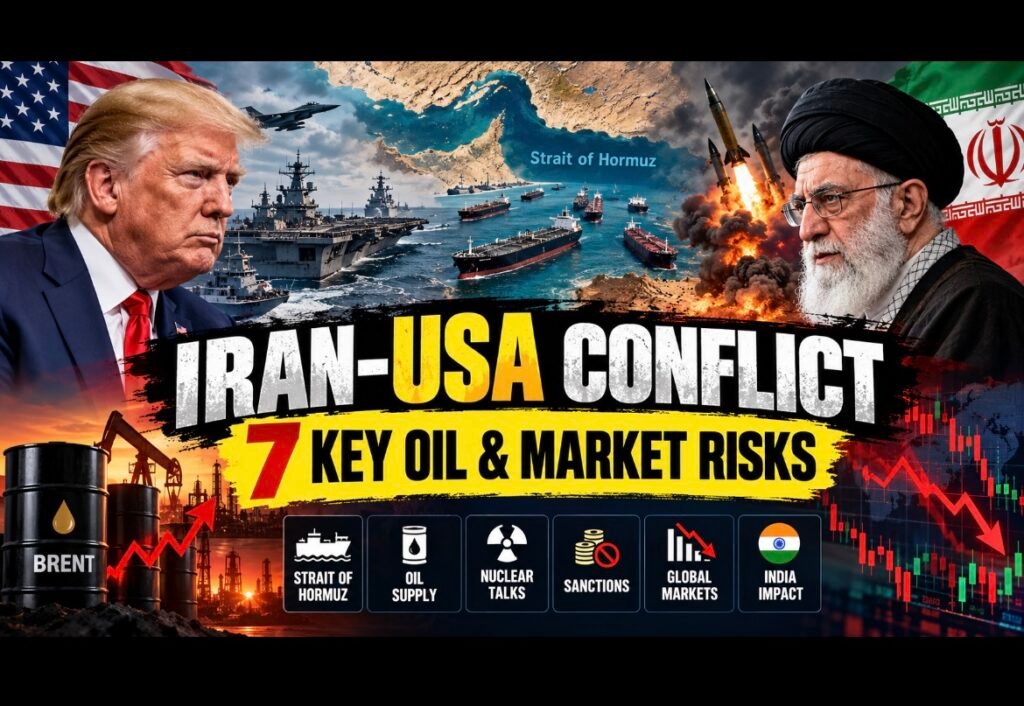
My research observation: The Iran–USA conflict has created two competing forces for the oil market. One is the risk of prolonged disruption around the Strait of Hormuz, military escalation and sanctions. The other is the possibility of diplomatic progress, higher shipping flows and eventual reopening of the Strait.
- Strait of Hormuz has remained the central market risk throughout this research period.
- Brent moved into the $100+ per barrel zone during periods of heightened geopolitical tension.
- U.S.–Iran diplomatic contacts continued through Qatar and other mediators, but several proposals failed to produce a confirmed ceasefire or full reopening of Hormuz.
- Iran linked Hormuz reopening with conditions including sanctions relief, removal of the U.S. naval blockade and a ceasefire.
- The U.S. continued sanctions and simultaneously strengthened its military posture.
- Iran’s side also discussed broader retaliation planning if U.S. attacks resumed.
- Some oil and LNG flows through Hormuz later showed signs of recovery, creating a counter-force against the oil spike.
- For India, the main transmission channel is simple: crude → import bill → rupee → inflation → corporate margins and market sentiment.
- I do not see this as a one-directional oil story. The biggest market move could come from either a credible diplomatic breakthrough or a fresh military/shipping escalation.
Iran–USA Conflict: How I Started Tracking the Market Risk
I have been following the Iran–USA conflict primarily from a market-research perspective rather than trying to predict the military outcome.
For me, the important question has been different:
What does each new development mean for crude oil, shipping, inflation, currencies and ultimately global equity markets?
The Strait of Hormuz quickly became the centre of this analysis.
The reason is obvious from a market perspective. Hormuz is a critical route for Middle Eastern energy shipments. Any sustained disruption can increase not only the physical supply risk but also insurance, freight and geopolitical risk premiums.
During the period covered by my research, several reports indicated that Hormuz traffic was materially below normal, while countries such as Iraq started looking for alternative fuel routes. Iraq was reported to have begun importing gasoline through Syria’s Baniyas port to bypass the disrupted route.
That was an important signal for me.
It showed that the problem was not simply a headline about a military confrontation. The disruption was beginning to affect actual regional energy logistics.
Strait of Hormuz Became the Biggest Oil-Market Variable
The most consistent pattern in my research was the relationship between Hormuz risk and crude prices.
At different points in the conversation, Brent was reported around:
| Market factor | Level / observation from research |
| Brent during peak tension | Around $105–107/bbl |
| Brent in later trading | Around $103/bbl |
| Brent during subsequent volatility | Around $100–102/bbl |
| WTI during elevated-risk period | Around $92–94/bbl |
| Brent September monthly move | Around 14% in Reuters reports referenced during the research |
| September Hormuz crude flows | Around 16.5 million bpd in later reports |
| September Gulf exports | Around 23.3 million bpd in one Goldman Sachs estimate cited in the research |
Some of these figures came from different dates and different methodologies, so I would not treat them as one simultaneous snapshot. [verify]
That distinction matters.
My observation is that the market was not simply pricing “oil supply is gone.” It was pricing uncertainty around future supply and shipping.
That is a different situation.
If ships continue moving, even at reduced levels, the immediate physical shortage can be smaller than the headline risk suggests.
But if commercial shipping is repeatedly attacked, the calculation changes very quickly.
Three Tankers Were Hit: Why This Became a Major Signal
One of the most important shipping developments in the research log came from reports that three Liberian-flagged oil tankers were hit by unidentified projectiles while transiting the Strait of Hormuz on September 29.
The critical point here is attribution.
The available reporting cited in my research did not establish who launched the projectiles. Therefore, I would not describe this as a confirmed Iranian attack.
For a market researcher, this distinction is extremely important.
An unidentified projectile hitting a tanker creates:
- higher insurance risk,
- higher shipping risk,
- potential delays,
- additional freight costs,
- and a larger geopolitical risk premium.
If such incidents become a pattern, the market reaction can be much larger than the reaction to a single isolated event.
My research framework therefore treats “confirmed Iranian retaliation” and “unidentified maritime incident” as two different categories.
U.S.–Iran Diplomacy: The Market’s Potential Relief Valve
At the same time that military and shipping risks were rising, diplomacy never completely disappeared.
Qatar became one of the key mediators between Washington and Tehran. Pakistan and other intermediaries were also mentioned during the negotiations.
Iran proposed a seven-day trust-building framework connected to the reopening of the Strait of Hormuz.
The proposal discussed during the research included conditions such as:
- removal or easing of the U.S. naval blockade,
- oil-sanctions relief,
- a ceasefire,
- and reopening Hormuz for commercial shipping.
The U.S. position was different. Washington continued to insist that any broader agreement would have to address Iran’s nuclear programme.
Eventually, reports said Iran received Washington’s response through Qatari mediators.
The important point is that receiving a response was not the same as reaching a deal.
The main disagreement was repeatedly described as the sequencing of reciprocal steps.
In simple terms:
Who moves first?
Does the U.S. provide relief first and Iran subsequently reopen Hormuz?
Or does Iran make commitments first and Washington then provide sanctions or blockade relief?
For oil markets, this sequencing question became extremely important.
Nuclear Issue: The Most Important Diplomatic Variable
The nuclear issue remained one of the biggest obstacles throughout my research.
Iran continued to resist major nuclear concessions, while the U.S. wanted concrete commitments concerning Iran’s nuclear programme.
Later, an important diplomatic signal emerged: Iranian Foreign Minister Abbas Araghchi was reported to have proposed access for international nuclear inspectors in exchange for sanctions relief. [verify]
If independently confirmed, this would represent a potentially important negotiating mechanism because it connects two issues that are otherwise difficult to separate:
Nuclear transparency ↔ sanctions relief
From a market perspective, any credible nuclear arrangement could reduce geopolitical risk even before every sanction is removed.
But again, there is a major difference between:
proposal → negotiation → agreement → implementation.
Financial markets generally react much more strongly to the last two stages.
Sanctions Continued Even While Talks Were Happening
Another recurring theme in my research was that diplomacy and economic pressure were happening simultaneously.
The U.S. announced several sanctions measures against Iran-linked networks.
The research log included sanctions targeting:
- military procurement networks,
- individuals and entities linked to Iran,
- organisations connected with weapons procurement,
- and later Iranian auto and rail-related sectors, including reports naming Iran Khodro (IKCO) and SAIPA. [verify]
There were also reports about Iranian oil tankers becoming stranded or facing difficulties obtaining services because of sanctions and shipping restrictions. [verify]
This creates an interesting market contradiction.
On one side:
Diplomacy → potentially lower oil risk premium
On the other:
Sanctions → potentially tighter Iranian export capacity
That is why I would not analyse Iran’s oil supply only through headline production numbers.
The more important question is:
Can the barrels actually reach the market?
U.S. Military Buildup Changed the Risk Calculation
One of the most significant developments later in the research was the reported increase in U.S. military assets in the Middle East.
Reports cited in the research said the U.S. was moving approximately:
- 9,000 additional personnel, and
- a third aircraft-carrier strike group
toward the region.
Additional air-defense assets, including Patriot systems, were also reported to be deployed around Saudi Arabia and Qatar to protect energy infrastructure. [verify]
This does not automatically mean a new attack will occur.
But from a market perspective, it changes the capacity for escalation.
That distinction matters.
A larger military presence means the market has to price a greater potential range of outcomes.
At the same time, Iranian commanders were reported to be preparing contingency plans for broader retaliation if large-scale U.S. attacks resumed, potentially extending beyond the Middle East. The reports also emphasized that this was contingency planning rather than a confirmed attack order.
Again, I prefer to separate planning from action.
U.S. Strategic Petroleum Reserve Added Another Variable
Another important U.S. response was the reported offer of up to 40 million barrels from the Strategic Petroleum Reserve (SPR).
My reading of this development is straightforward.
If geopolitical risk pushes crude higher, additional strategic supply can act as a short-term cushion.
It does not solve a prolonged Hormuz disruption.
But it can reduce the immediate physical shortage and potentially limit the speed of an oil-price spike.
So I started looking at two separate oil-market variables:
1. Physical supply risk
and
2. Strategic supply response
The interaction between these two can be more important than either one individually.
What Happened to LNG and Shipping Flows?
One of the more interesting developments later in the research was the recovery in LNG traffic through Hormuz.
Reuters/Kpler-related figures cited in the conversation indicated that September LNG cargoes through Hormuz had increased, with roughly 19–21 cargoes reported depending on the tracking source. [verify]
However, this was still substantially below normal pre-conflict traffic.
That is why I would describe the situation as:
partial recovery — not normalisation.
The same logic applies to crude exports.
Later research cited September Hormuz crude flows around 16.5 million barrels per day, substantially higher than some earlier crisis-period levels.
This was one reason oil prices could fall below the earlier $105–107 zone even though the geopolitical conflict had not completely disappeared.
The market was beginning to price the possibility that some energy flows could continue despite the conflict.
How I See the Oil–Nifty Connection
For an Indian market researcher, the Iran–USA story cannot stop at Brent.
India is heavily dependent on imported crude, so I look at the chain like this:
Iran/USA escalation
↓
Hormuz/shipping risk
↓
Brent crude
↓
India’s import bill
↓
USD/INR
↓
Inflation expectations
↓
Corporate margins + interest-rate expectations
↓
Nifty / broader Indian equities
During the research period, the rupee was reported around ₹96 per dollar, including a level of approximately ₹96.315/$ in one Reuters report. Indian equities also came under pressure during periods of higher crude and foreign selling. [verify exact session/date before publication]
This is why I consider crude one of the most important variables for Indian markets during this conflict.
I am not saying that every $1 move in Brent automatically produces a specific Nifty-point move. Markets do not work that mechanically.
But the direction of the pressure can be understood.
If Hormuz remains disrupted
Crude ↑ → import bill ↑ → INR pressure → inflation risk ↑ → Indian equities face pressure
If Hormuz genuinely reopens
Crude ↓ → import pressure ↓ → INR support → inflation risk ↓ → Indian equities can get relief
The actual market response would still depend on global rates, FII flows, earnings, domestic liquidity and other macro factors.
The Three Scenarios I Am Watching
I don’t want to reduce this entire situation to a simple bullish or bearish call.
My research framework currently has three broad scenarios.
1. Diplomatic breakthrough
If the U.S. and Iran reach a credible agreement involving:
- ceasefire,
- sanctions arrangements,
- nuclear-inspection framework,
- and secure reopening of Hormuz,
then I would expect the geopolitical premium in crude to come under significant pressure.
That would potentially be supportive for global equities and particularly relevant for oil-importing economies such as India.
2. Prolonged negotiation without resolution
This is a more complicated scenario.
Shipping gradually improves, but Hormuz does not fully normalise.
Oil remains elevated but volatile.
Markets repeatedly react to headlines.
This environment can produce large intraday moves without creating a clear long-term direction.
3. Military escalation
This is the highest-risk scenario for oil.
A confirmed U.S. strike, confirmed Iranian retaliation, attack on Gulf energy infrastructure or repeated tanker attacks could quickly push the risk premium higher.
If Hormuz traffic falls materially at the same time, the physical supply story becomes much more serious.
My Current Research Dashboard
| Variable | My research observation |
| U.S.–Iran diplomacy | Active but fragile |
| Hormuz | Partially recovering, not fully normal |
| Nuclear issue | Major negotiation obstacle |
| U.S. sanctions | Continuing / expanding |
| U.S. military posture | Significantly strengthened |
| Iranian retaliation risk | Elevated; contingency planning reported |
| Oil | Highly headline-sensitive |
| Brent | Has traded around/above $100 during escalation |
| LNG traffic | Partial recovery reported |
| Global equities | Sensitive to crude and escalation |
| India/Nifty | Vulnerable to sustained high crude |
| Biggest positive catalyst | Credible ceasefire + Hormuz reopening |
| Biggest negative catalyst | Confirmed military escalation + shipping disruption |
What I Will Watch Next
For my market research, I would give the highest weight to actual events rather than rhetoric.
The signals I would monitor are:
- Any confirmed U.S. military strike
- Confirmed Iranian retaliation
- Another tanker or LNG vessel attack
- Actual reopening of commercial Hormuz traffic
- A concrete U.S.–Iran ceasefire
- Nuclear-inspection agreement
- Sanctions relief with implementation
- Major changes in Gulf crude/LNG flows
- Brent sustaining or losing the $100 area
- USD/INR reaction and Indian equity flows
For me, the distinction between a headline and an actual change in physical oil flows is critical.
A political statement can move Brent for an hour.
A genuine change in Hormuz shipping can change the market for weeks.
That is the difference I want to keep tracking.
Final Research View
My observation from following this situation is that the Iran–USA conflict has become much more than a geopolitical headline for financial markets.
It is now a connected system involving oil, shipping, LNG, sanctions, military positioning, nuclear negotiations, currencies, inflation and equity-market risk.
The most important variable remains the Strait of Hormuz.
If shipping gradually normalises while diplomacy progresses, the oil-risk premium can unwind quickly.
If negotiations fail and military activity expands, the opposite can happen.
I therefore don’t think it is useful to look at one Brent price or one headline and declare the market direction.
I would rather track the chain:
Diplomacy → Hormuz → physical energy flows → Brent → USD/INR → inflation → global equities → Nifty.
That is the framework I will continue using in my own market research.
FAQ
1. Why is the Strait of Hormuz so important for oil markets?
Hormuz is a major energy-shipping chokepoint. Any sustained disruption can affect crude and LNG transportation, shipping insurance, freight costs and the geopolitical risk premium embedded in oil prices.
2. What happens to oil if the U.S. and Iran reach a deal?
If a credible agreement includes a ceasefire and reliable reopening of Hormuz, the geopolitical risk premium in crude could decline significantly. The actual price response would depend on how quickly physical shipping normalises.
3. Why does high crude matter so much for India?
India imports a large amount of crude. Higher oil prices can increase the import bill, put pressure on the rupee and influence inflation expectations. These factors can affect Indian equities and corporate margins.
4. Does every Iran–USA escalation mean Brent will rise?
Not necessarily. Oil also depends on actual physical supply, alternative export routes, inventories, demand, OPEC+ policy and global economic conditions. That is why I track shipping and export data alongside geopolitical headlines.
5. What is the biggest market trigger I am watching?
The two highest-impact developments are a credible Hormuz reopening/ceasefire agreement and a confirmed military or shipping escalation that materially disrupts energy flows.
Disclaimer
Disclaimer: I am not a SEBI-registered investment advisor or financial advisor. This article is based on my own personal research and is shared purely for educational and informational purposes. It should not be treated as investment, trading or financial advice. Stock market, futures & options, commodities, currency and crypto trading involve high risk and you may lose your capital. Please do your own research and consult a SEBI-registered investment advisor before making any financial decision. The author and website are not responsible for any profit or loss.