
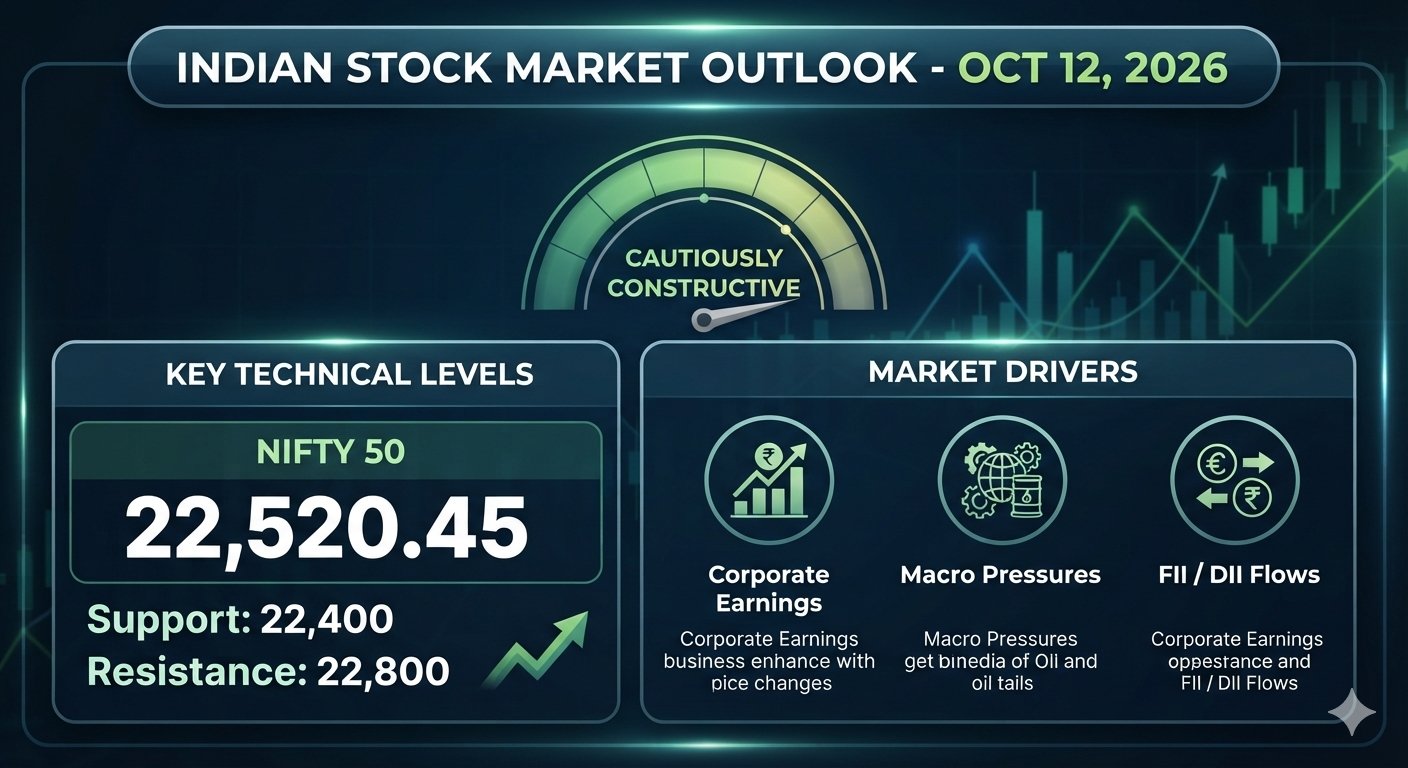

Indian Stock Market Outlook for Monday, October 12, 2026: How Much Could Nifty, Bank Nifty and Sensex Move?
RBI Policy, Crude Oil, Iran–US Tensions and Global Market Signals: A Complete Overview
The Indian stock market is heading into Monday, October 12, 2026, with several important domestic and global factors in focus. The Reserve Bank of India’s liquidity measures, crude oil prices, the rupee’s movement, global market trends and upcoming economic data could influence investor sentiment.
Although the market witnessed a recovery in the previous trading session, one positive session does not necessarily confirm the beginning of a new bullish trend. Investors and traders will be watching whether the recovery continues or selling pressure returns.
This article examines the key market triggers, potential movements in Nifty 50, Bank Nifty and Sensex, and the factors investors and traders should monitor before making decisions.
1. What Will Drive the Market on Monday?
Several factors could influence the Indian market at the start of the week:
- RBI’s bond sale and liquidity conditions in the banking system.
- Iran–US tensions and risks to oil supplies through the Strait of Hormuz.
- Brent crude prices and the USD/INR exchange rate.
- Indian and US inflation data.
- Foreign institutional investor (FII) buying and selling.
- Q2 FY27 corporate earnings and management guidance.
These factors should be evaluated together rather than in isolation. Even negative news may fail to push the market lower if it has already been priced in or if other indicators turn positive.
2. Potential Impact on Nifty 50, Bank Nifty and Sensex
The following ranges illustrate a possible downside scenario for Monday. They are not guaranteed targets or predictions of the market’s actual direction.
| Index | Potential downside | Estimated percentage |
| Nifty 50 | 100–250 points | Approximately 0.44%–1.11% |
| Bank Nifty | 200–600 points | Approximately 0.36%–1.09% |
| Sensex | 300–800 points | Approximately 0.41%–1.10% |
These estimates are based on the closing levels referenced in the earlier market discussion. Actual movements will depend on opening levels, global cues, volatility and buying or selling pressure.
Important: These are illustrative downside scenarios, not forecasts generated by a validated predictive model. If global cues improve, the market could move in the opposite direction.
3. RBI Bond Sale and Liquidity: Why It Matters
The RBI has scheduled an auction to sell government bonds worth ₹25,000 crore on October 13. In general, when a central bank sells bonds, buyers pay for those securities, which can withdraw liquidity from the banking system.
This may affect banking liquidity and bond yields. Market participants will also assess whether sufficient liquidity remains available in the banking system and how other RBI measures influence the overall situation.
For Bank Nifty, this is an important factor to monitor. However, a bond sale does not automatically mean banking stocks will decline. Corporate earnings, credit growth, deposit costs and market expectations will also influence their performance.
4. Iran–US Tensions and Brent Crude: A Major Risk for India
India imports a substantial portion of its crude oil requirements, making developments in the Middle East particularly important for the domestic economy and equity markets.
If Iran–US tensions escalate or shipping through the Strait of Hormuz is disrupted, Brent crude prices could rise. Higher oil prices may increase India’s import bill and put pressure on the rupee and inflation.
Conversely, progress in diplomatic negotiations and reduced concerns about oil supply could ease crude prices, providing relief to Indian equities.
The following sectors deserve particular attention:
- Aviation: Higher fuel costs may put pressure on operating margins.
- Paints and chemicals: Raw material costs could increase.
- Oil marketing companies: Retail fuel prices and marketing margins will influence the impact of crude price movements.
- Oil producers: Higher crude prices may benefit some producers.
- The rupee and broader market: Expensive oil could put pressure on the currency and inflation.
5. Three Possible Market Scenarios for Monday
Scenario 1: The Market Moves Higher
If GIFT Nifty indicates a positive opening, Brent crude declines and Nifty sustains above its initial resistance, a recovery or short-covering rally could develop.
In this situation, taking a bearish position solely because of previously reported negative news could be risky.
Scenario 2: The Market Declines
If crude prices rise sharply, the rupee weakens and selling pressure continues, Nifty and Bank Nifty could face further weakness.
Even under these conditions, traders should look for confirmation through price action and key technical levels before entering a position.
Scenario 3: The Market Trades Sideways
If positive and negative factors offset each other, the market may trade within a range without establishing a clear direction.
Repeatedly entering trades in such conditions can increase transaction costs and losses. Waiting for a clear setup may be the more disciplined approach.
6. What Should Investors and Traders Do?
For Long-Term Investors
Avoid making major investment decisions based on a single trading session. Focus on company fundamentals, valuations, debt levels and earnings prospects.
A market decline may provide an opportunity to reassess strong companies, but a falling share price alone does not make a stock attractive.
For Intraday Traders
Allow the market to establish its initial direction before committing to a trade. Monitor GIFT Nifty, crude oil, the rupee and the price action of the major indices.
Define the stop-loss and maximum acceptable loss before entering a position.
For F&O Traders
Avoid buying calls or puts solely on the basis of a headline. A gap-up or gap-down opening is not, by itself, a trading signal.
Options premiums can change rapidly when volatility increases. Position sizing, risk limits and confirmation of the trading setup are therefore essential.
Conclusion: What Should Market Participants Expect on Monday?
For Monday, October 12, 2026, a cautious approach is reasonable. RBI liquidity measures, crude oil prices and geopolitical tensions create potential downside risks, but they do not guarantee a decline in Nifty, Bank Nifty or Sensex.
Under a downside scenario, Nifty could potentially decline by 100–250 points, Bank Nifty by 200–600 points and Sensex by 300–800 points. These ranges are illustrative estimates, not firm market targets.
The most useful approach is to monitor GIFT Nifty, Brent crude, USD/INR, FII activity and the market’s initial price action together. A disciplined strategy, appropriate position sizing and effective risk management matter more than any single market prediction.
https://finecodefinanceai.com/iran-usa-conflict-strait-of-hormuz-oil-market-impact/
Disclaimer: This article is for informational and educational purposes only. The figures represent illustrative scenarios, not guaranteed outcomes or personalised investment advice. Verify the latest official announcements and market data before making investment or trading decisions.