

Congo Ebola Outbreak 2026: Cases Rise to 782 as New Health Zones Report Infections
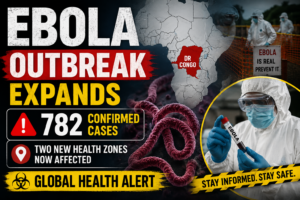
A growing Ebola outbreak in the Democratic Republic of Congo (DRC) is drawing increased attention from global health authorities after confirmed infections climbed to 782 cases, with the virus spreading into additional health zones. While the outbreak remains concentrated in central Africa, the latest developments highlight the importance of monitoring global health risks that could eventually influence economic activity, investor sentiment, and market stability.
At present, financial markets are largely focused on inflation trends, interest rate expectations, crude oil prices, and geopolitical developments. However, history has shown that major health emergencies can quickly become economic concerns if containment efforts fail or transmission expands across borders.
What Happened?
Health authorities in Congo reported a significant rise in confirmed Ebola infections, bringing the total number of cases to 782. In addition, the outbreak has now spread into two new health zones, increasing concerns about the geographical expansion of the virus.
The latest increase suggests that community transmission remains active despite ongoing containment efforts. Therefore, health officials continue to strengthen testing, surveillance, contact tracing, and treatment programs across affected regions.
Moreover, the outbreak involves the Bundibugyo strain of Ebola, a less common variant for which there is currently no widely approved vaccine. As a result, authorities are relying heavily on early detection and rapid response measures to slow the spread of infections.
Why This Matters
Although Ebola outbreaks are not uncommon in parts of Central Africa, the current situation is attracting greater attention because of its continued expansion and the challenges facing containment efforts.
Furthermore, healthcare systems in some affected regions are operating under difficult conditions, including limited medical infrastructure, population displacement, and security concerns. These factors can make outbreak management more complicated and increase the risk of undetected transmission.
In addition, global health agencies are monitoring the situation closely because infectious disease outbreaks can create broader economic consequences if they spread beyond their initial regions.
Impact on Global Markets
For now, the direct impact on global financial markets remains limited. Investors are currently paying greater attention to major macroeconomic events, including central bank decisions, inflation data, energy markets, and geopolitical tensions.
However, large-scale health emergencies can affect market sentiment if they begin to disrupt travel, trade, supply chains, or consumer activity.
For example, sectors that could become sensitive to a worsening outbreak include:
- Travel and tourism
- Transportation and logistics
- Regional trade activity
- Consumer-facing businesses
- Healthcare and pharmaceutical companies
Meanwhile, companies involved in medical diagnostics, disease surveillance, and healthcare services could attract increased investor attention if governments expand response efforts.
Therefore, while the outbreak is not currently a major market-moving event, it remains a developing risk that investors should continue monitoring.
Why Should Investors Care?
Investors should understand that markets often react not only to current conditions but also to future risks.
At the moment, the Congo Ebola outbreak is primarily a public health issue. Nevertheless, continued growth in confirmed cases or evidence of wider international transmission could influence global risk sentiment.
Moreover, governments and international organizations may increase healthcare spending, emergency response funding, and disease surveillance programs if the outbreak expands further.
Consequently, developments related to containment efforts, case growth, and international response measures could become more important for investors in the coming weeks.
Investor Takeaway
The current Ebola outbreak does not represent a significant threat to global financial markets at this stage. However, the rapid increase in confirmed cases and the expansion into new health zones suggest that the situation deserves close monitoring.
Investors should focus on whether containment measures are successful and whether infections remain largely confined to affected regions. Furthermore, any signs of cross-border acceleration or broader international concern could increase market sensitivity to health-related risks.
For now, the outbreak remains a secondary concern compared with inflation, interest rates, and geopolitical developments. Nevertheless, prudent investors should continue following updates from health authorities and global organizations.
Final Outlook
The Congo Ebola outbreak has entered a critical phase, with confirmed cases reaching 782 and new health zones reporting infections. Moreover, the latest developments highlight the ongoing challenges facing healthcare authorities as they work to contain the virus.
However, financial markets have so far remained largely unaffected because investors are focused on larger macroeconomic and geopolitical themes. As a result, the immediate market impact remains limited.
Nevertheless, health emergencies can evolve quickly. Therefore, investors should continue monitoring developments, particularly if case numbers continue rising or the outbreak expands geographically.
At present, the outbreak represents a growing public health concern rather than a major market risk. The coming weeks will be crucial in determining whether containment efforts can successfully slow transmission and prevent wider escalation.
Disclaimer: This article is for informational and educational purposes only and does not constitute investment, financial, medical, or professional advice. Readers should conduct their own research and consult qualified professionals before making decisions based on information discussed in this article.